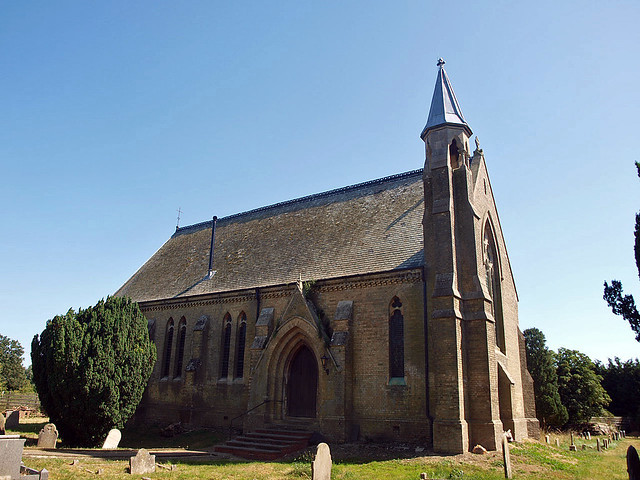
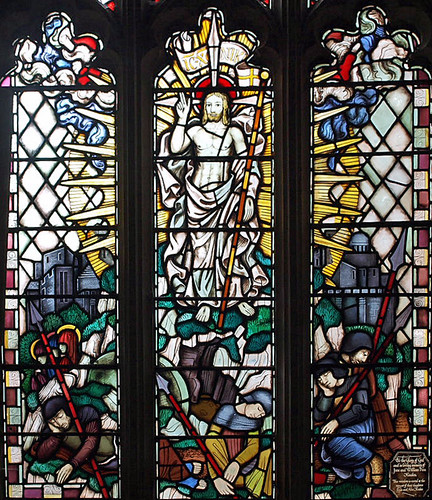
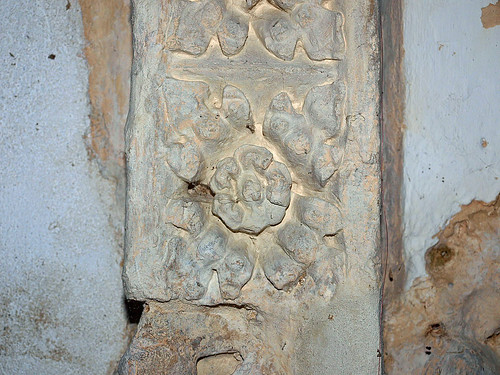
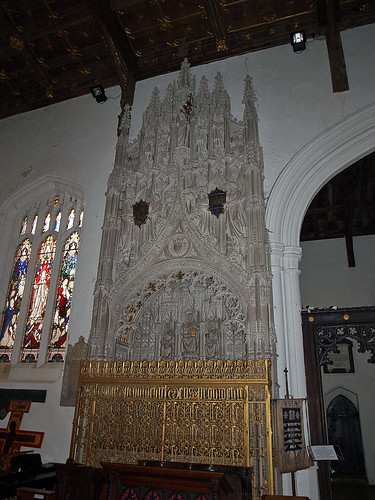
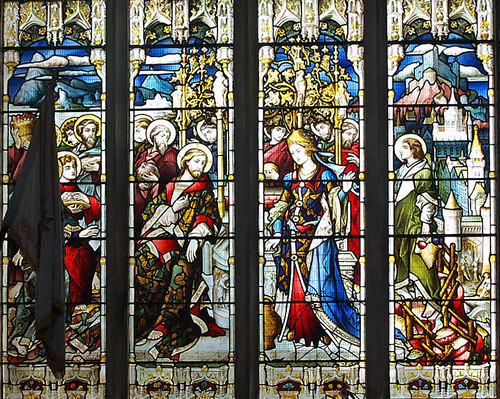
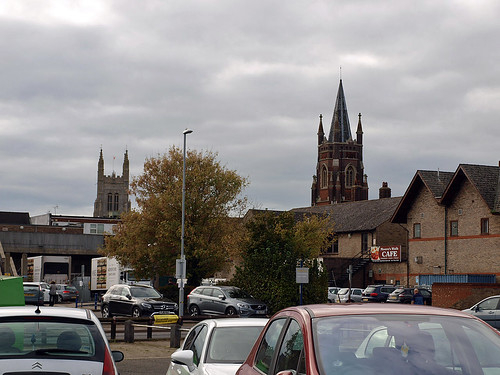
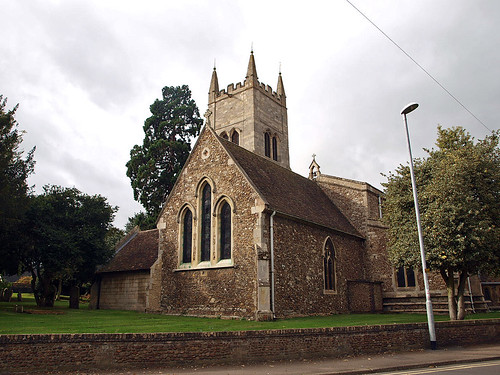
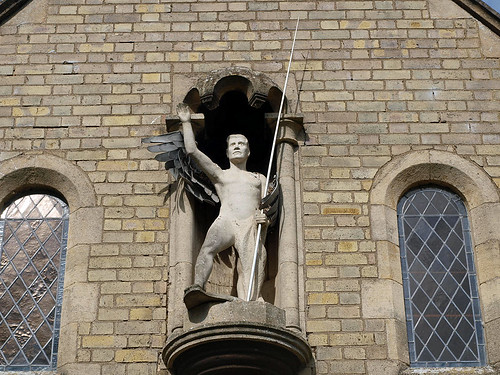
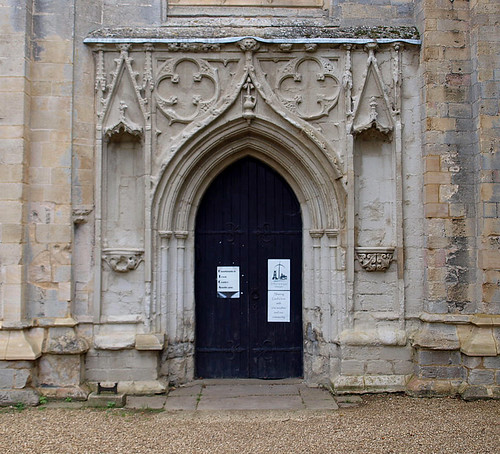
St Michael is one of those oddities - a locked, no keyholder, Catholic church.
ST MICHAEL (R. C.), Hartford Road. 1900-1 by A. J. C. Scoles.* Brick and stone, round-arched.
* According to Mr Dickinson
HUNTINGDON.
Its streets have resounded with the tramp of Roman legions. The Saxons
set a castle on the little green hills at the back of its square. The
Normans built the school where Oliver Cromwell and Samuel Pepys both
went as boys. Little can the people of Huntingdon who would see these
boys playing in their streets have imagined that one would raise England
to the height of power beyond the dream of kings, and that the other
would leave behind him a picture of the life of England to be read for
centuries.
It is enough to give a town a sense of great
importance, yet Huntingdon makes no pretence to greatness; it is just
an old-fashioned place where many things have happened. It has not
thought it worth while to set up a statue of Oliver Cromwell at one end
of its street and a statue of Pepys at the other; it was not until the
other day that this old town had a single record in stone of the fact
that it gave Oliver Cromwell to the world.
Milton’s
Chief of Men, our greatest man of action, was born at the bottom of
Huntingdon’s long street. The long brick wall is here as it has been for
centuries, for it was the boundary wall of the Augustinian Priory, and
in the garden over the wall Cromwell would play in his boyhood. It is
all there is to see of his birthplace as he knew it, for his house has
gone. It is possible that part of the house now standing here may belong
to the birthplace, and certainly much of the old materials was used;
and it is certain that Cromwell’s garden was bounded by these brick
walls. There is an arch that he would walk through, and, however changed
the scene may be, it was here that that life began which shook the
English throne, established securely the fame and freedom of our people,
and gave history for all time a man to wonder at.
We
walk about the scenes of his boyhood. He would walk from here along this
street to the little Norman schoolroom facing the church in which he
was baptised. The record of his birth and baptism are in the registers
at All Saints, and there his father lies. Here his mother is not, for
Oliver was to take her up to the Palace of Whitehall and lay her at last
in the loveliest shrine in London, the Chapel of Henry the Seventh,
where a dissolute king was to dig up her remains and throw them into a
pit.
It is believed that she had great influence with
Oliver in his early days. The story is that he was the terror of the
neighbourhood, living a wild life, so that the ale-wives of Huntingdon
were afraid of him. When the time came that his means would not allow
extravagance (and especially when his rich Uncle Oliver at
Hinchingbrooke became displeased with him), the brewer’s son changed his
ways and gave way to his mother’s persuasions.
We may
think that the little school looking down on the pavement of this long
street is the most intimate Cromwell monument we have. It stands on the
Roman way called Ermine Street, and it has still looking into the street
a magnificent Norman doorway, a Norman window, and a row of five Norman
arches. It is thrilling to us not only as a piece of Norman England, the
hall of a 12th century hospital which became in time the grammar school
of Huntingdon, but because to this little place came two boys whose
names are famous throughout the world, Oliver himself, and Pepys. Pepys
spent some of his boyhood in a village near by, and lived to see the
great Oliver’s head stuck on a post at Westminster Hall, and to write in
his diary that night that he did see this thing and did think it an
indignity for a man so great.
Oliver’s father is
described as having been extremely careful with his education, first
putting him under Mr Long, a minister of Huntingdon, and then removing
him to the grammar school under Dr Beard. It is stated somewhere that
the boy had fits of learning, “now a hard student for a week or two,
then a truant for a month or two, and of not settled constancy.” It was
during his schooltime here that he was flogged by Dr Beard for telling
the story of a vision in which he saw a gigantic figure opening the
curtains of his bed and declaring that he should be the greatest person
in the kingdom. Whether that be true or not, it appears to be true that
during his schooldays here the comedy of Lingua was played and nothing
would satisfy Cromwell but the part of Tactus. The idea of the comedy,
which was first printed in 1607 and first acted at Trinity College,
Cambridge, is a combat between the Five Senses for superiority, and one
of the scenes in the first act is a conversation between Tactus and
Mendacio, during which Tactus fumbles with a crown:
Tactus: A crown and robe!
Mendacio: It had been better for you to have found a fool ’s coat, and a bauble.
Tactus: Tis wondrous rich: ha! but sure it is not so: Do I not sleep and dream of this good luck?
Then comes a scene in which Tactus is soliloquising:
This crown and robe,
My brows and body circle; and invests,
How gallantly it fits me, sure the slave
Measured my head that wrought this coronet,
They lie who say complexions cannot change,
My blood’s ennobled, and I am transformed
Unto the sacred temper of a king.
Methinks I hear my noble parasites
Styling me Caesar, or great Alexander,
Licking my feet, and wondering where I got
This precious ointment, how my pace is mended,
How princely do I speak, how sharp I threaten:
Peasants, I’ll curb your headstrong impudence,
And make you tremble when the lion roars.
It
is believed that Huntingdon rejected the statue of Cromwell now
standing in St Ives, but its mayor and corporation made amend by giving
their blessing to the stone set in 1938 by the Norman doorway, recording
the fact that Cromwell attended this school. It is the only memorial of
Cromwell in the town, and was presented by the Cromwell Association in a
speech by Mr Isaac Foot and unveiled by the Earl of Sandwich, who
arranged for its beautiful heraldic carving to be copied from the badge
on Cromwell’s leather water bottle, which is now at Hinchingbrooke, the
superb Tudor house of the Cromwells a mile away.
Looking
across at this stone from the walls of All Saints Church is another
curious stone, engraved in the 18th century with a moral lesson for all
who pass by. It is to Thomas Jetherell, a maltster who died in 1774 and
is declared to have been an example of piety in life and honesty in
death. Bankruptcy brought his character under a cloud, but religion
inspired him to bequeath all his acquisitions after that (which were
considerable) to his creditors, so that if he scandalised the world by
some miscarriages he repaired them to the utmost of his power, choosing
to leave his relations in want rather than transmit to them a patrimony
of malediction, rather giving them an example of equity than the fruit
of injustice.
All Saints is one of two fine churches in
Huntingdon; it has two old churches and two old inns. The churches are
medieval, and the inns are 17th century. The Falcon has a cobbled
courtyard with a long window over the gateway, and the George has a
picturesque galleried yard with an oak staircase leading to a painted
balcony.
The stately south front of All Saints looks
out on the marketplace, an impressive background for the little square
with its great aisle windows, the clerestory receding above, and the
14th century tower beyond. It has richly sculptured walls, a pinnacled
and battlemented tower of the 14th century, and buttresses guarded by
figures under canopied niches. The church is mainly 15th century.
Inside, the eye is drawn by the beauty of the old chancel roof, its
cornice carved with small faces, the beams adorned with tiny winged
angels in gold, while eight great angels reach out from the walls
looking down on the musical angels crowning the stalls. Everywhere on
this roof are roses and crowns and stars, flowers and knots and shields,
and bearing up the beams on the walls are wooden figures of saints
resting on brackets of grotesque creatures in stone. Under this roof
there rested for a night the body of Mary Queen of Scots on its way from
her old grave in Peterborough to her new grave in Westminster Abbey.
The
font at which Cromwell was baptised is older than the church it stands
in; the bowl is 13th century, set on a new arcaded stem. The stained
glass windows which darken the church have kneeling apostles, saints,
and martyrs, including a Roman matron, St George and St Pancras, and men
carrying models of Ely and Lincoln Cathedrals. The clerestory windows
have 21 painted saints. Over the doorway in memory of Alice Weaver is
her kneeling figure in alabaster, with her husband and six children; she
would be stirred by the news that her famous townsman was leading the
fight of the Parliament against the king.
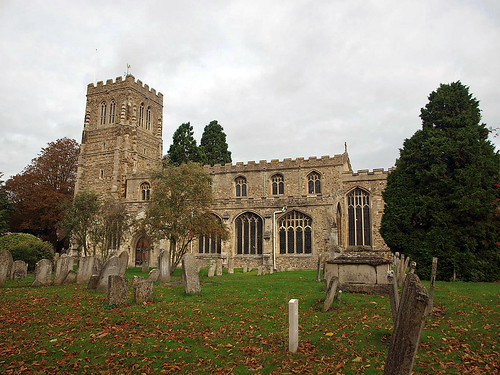
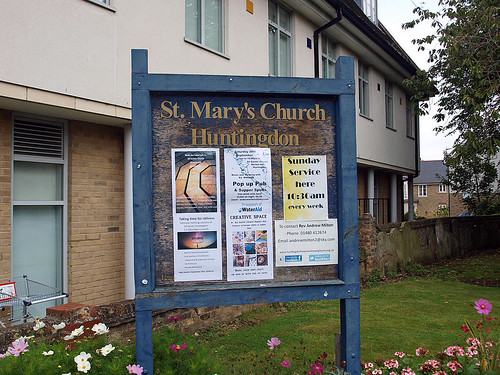
St Mary’s
Church comes from all our great building centuries, the chancel 13th,
the tower and the west porch 14th, the clerestory 15th. It has at two
corners of the south aisle fragments of Norman buttresses from which it
is clear that the Norman church on this site must have been of great
size. The chancel walls were raised when the clerestory was built in the
15th century; the north arcade of three bays was refashioned with the
old material 300 years ago; the south arcade is the original 13th
century. The tower is magnificent with pinnacles, a band of decoration
below its battlements, and a charming doorway with a canopied niche on
each side. About 600 years ago somebody scratched a drawing of a bell on
one of its stones and the winds and rains of centuries have left it
clear. In the south wall is a beautiful doorway through which priests
have passed about 700 years.
The church is crowded with
interest and beauty; it has a remarkable collection of small things.
Hanging on the west wall is a group of flags among which is one captured
from the Sikhs in 1846, a Boy Scout flag hanging with the flag flown in
the Great War by HMS Walpole, and three fine banners made in Bruges.
There are hanging lamps copied from old Italian and old Spanish lamps,
two oak chests restored in the 17th century, two high-backed walnut
chairs of Restoration days, an Elizabethan chalice, a 200-year-old copy
of Guercino’s Holy Child, and a tiny fragment of a 14th century screen
which is all that is left of the vanished church of St Benedict. In the
south chapel are carved wooden figures and a beautiful Madonna in
plaster, and in the north chapel is a fine gilt figure with outstretched
arms, carved in wood by a craftsman in a Belgian village. One of the
altars has a frontal of‘ great beauty made in Bruges, showing the angels
bringing the good news to Mary. The chancel altar rails are by J. N.
Comper, the gold angels on the uprights coming from Austria.
Set in the wall by the 13th century chancel arch is a small stone deeply cut with the names:
R. Cromwell, I. Turpin, Bailiffs 1609.
High above the chancel arch are four ancient figures carved out of
solid oak about the end of the 15th century. They show four apostles,
Stephen, Bartholomew, Jude, and Matthew, all carrying the Gospels and
their emblems—flaying knives, a boat, and a carpenter’s square. Few
small towns are more interesting out of doors than Huntingdon. It has
fine old houses, stately churches, deserted churchyards, a noble bridge,
an 18th century town hall extended just after Waterloo; the 18th
century house in which the poet Cowper lived; the 17th century Walden
House (now used by the County Council) with some 16th century woodwork;
an 18th century house built by the Ferrars of Little Gidding with a
little stained glass of Stuart days; the great ancestral home of the
Cromwells, and, of course, the famous mound on which the ancient castle
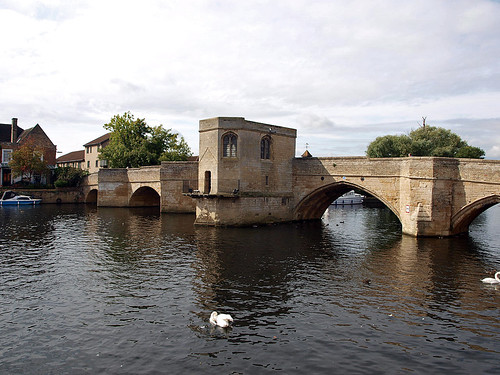
stood. We see it from the bridge which shares its fame as part of the
oldest spectacle in this old town. The bridge, from which we see
Huntingdon at its best, leads on to the great Causeway which links the
town with Godmanchester. It is one of the loveliest stone bridges in
England, as good a piece of stonework as the 13th century has left us,
with carving over some of its arches, and with bays to protect the
traveller from the dangers of its narrow way. From it we look across to
the spacious green meadows with the great mound, the elegant spire of
Trinity Church rising above the roofs behind. Not far from where we
stand is the long graceful house fronting the street, with dormers and a
central pediment, where William Cowper came to live with "the most
agreeable family in the world.”
Cowper came to
Huntingdon in the summer of 1765, finding himself very soon on good terms
with “no less than five families, besides two or three odd scrambling
fellows like myself.” One of them was the Unwin family, destined to have
so great an influence on his life; another was a North Country parson
who travelled on foot 16 miles every Sunday to serve his churches, and
who invited Cowper to supper on bread and cheese and a black jug of ale
of his own brewing. Another friend the poet met was a thin, tall, old
man as good as he was thin, drinking nothing but water and eating no
meat, and to be met every morning of his life at 6 o’clock at a fountain
a mile from the town. His great piety, said Cowper, was equalled by
nothing but his great regularity: he was the most perfect timepiece in
the world. As for Mrs Unwin, he met her in the street and went home with
her and they walked for two hours in the garden, having a conversation
which “did me more good than I should have received from an audience of
the first prince of Europe.” He knew also the woollen draper, “a
healthy, wealthy, sponsible man”; he had a cold bath and had promised
the poet the key of it.
In the little market square on
which the 12th century grammar school, the 15th century church, and the
18th century town hall look down, stands one of the best of all our
peace memorials, a monument in bronze which somehow reminded us of The
Thinker by‘Rodin; it is by the widow of Captain Scott (Lady Kennet), and
shows a soldier sitting with his head resting on his hand. Four
centuries have given something to this heart of Huntingdon, and here
have stood these famous men who belonged to this small place: Cromwell,
Pepys, Cowper. But the roll begins earlier and ends later than these,
for Henry of Huntingdon wrote a 12th century history of England, and Sir
Michael Foster, one of the greatest physiologists who ever lived, was
born here on the eve of the Victorian Era and lies in the cemetery. He
sleeps not far from where he first opened his eyes, but most of his long
life he was away, though he joined his father’s Huntingdon surgery for a
few years in the sixties of last century. At 31 he began teaching
physiology in University College, London, and a few years later left for
Cambridge, where Huxley recommended him for a post. He presided over
the British Association, went into Parliament, founded a scientific
society, and wrote a famous text book.
The Cromwell
House at Huntingdon has vanished except for the bricks of its walls,
which may be its successor; but the Cromwell House of Hinchingbrooke,
where it is believed Oliver had his first encounter with Charles,
remains in all its glory just outside the town.