Friday, 22 September 2017

St Ives

I'm feeling lazy so I'm going to do the three buildings in one entry.

First. All Saints, locked several keyholders listed - which is all well and good but when I fished out my phone I found it had died. Pevsner makes it sound worth a revisit.

It's a big church set in a lovely churchyard besides the Great Ouse and externally satisfying, particularly the tower. I look forward to an internal visit.

Next was the bridge with St Leger's chapel which is a delight and finally the Free church which isn't.

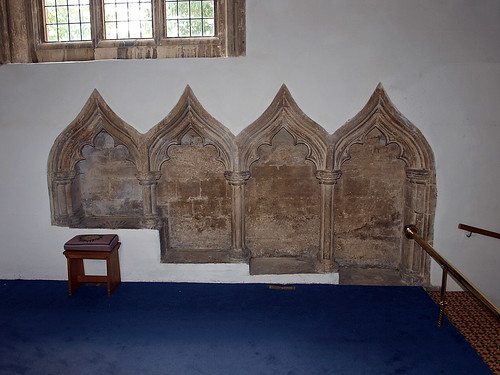
ALL SAINTS. In an enviable position by the Ouse and normally reached by a footpath from The Waits. It is a large church built mostly between c.1450 and c.1470, and its steeple is exceptionally fine in its proportions. The bell-openings are pairs of slender two-light openings, Perp, and the spire is recessed but has low broaches behind the battlements and pinnacles. Two bands run across it and contain the lucarnes, the upper ones being just quatrefoils. The W door is very elaborate, with two niches l. and r. The aisles and the chancel are also all Perp, except for the C13 N doorway with a hood-mould on head stops and the latest C13 S aisle E window of five lights with intersecting tracery broken at the top to allow for an encircled quatrefoil. Inside the S aisle is a splendid DOUBLE PISCINA with a surround of big dog-tooth. Each half has a pointed arch, but they are taken together by a round arch. The date could be as late as that of the E window, but is more likely to be earlier in the C13. The interior is as obviously Perp as the exterior. Arcades of high thin piers and thin arches; four bays. Against the piers a whole series of brackets for images, all decorated, some with foliage, one with a dog, another with a bull baited by a dog. High tower arch and tierceron-star vault in the tower. Embracing aisles. Two niches in the S aisle E wall. - FONT. Octagonal, Norman, with blank intersecting arches. - PULPIT. Elizabethan, with very elongated blank arches and panels with elementary geometrical motifs. - The vast ORGAN, in the Bodley tradition, is by Comper, 1893. - He also did the imitation-German STATUES on the brackets. - STAINED GLASS. Much by Wailes, also one window by Kempe, 1903 (chancel S) and one by Comper, 1896 (S aisle). - PLATE. Two large engraved Flagons of 1779-80; Processional Cross, Italian, C15 or early C16; bronze and brass Altar Cross, Venetian, c.1540. - MONUMENTS. Many tablets, e.g. a bulgy cartouche d. 1728 (a late date for the type). A tablet d. 1857 has a kneeling Hope by a Bible and an urn (also late for its type).

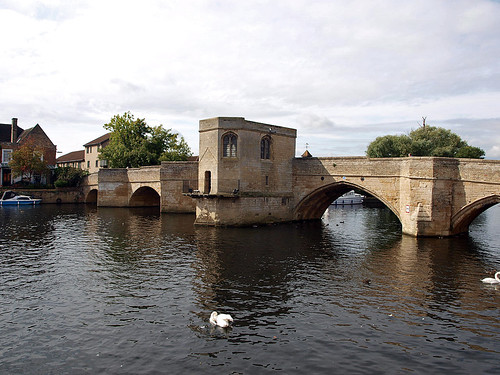
The BRIDGE is the most memorable monument of St Ives. May the temptation be resisted to sacrifice it to a through-traffic which should not at all rush along here. The bridge is still narrow and has preserved its cutwaters on both sides. It dates from about 1415. Midway along it is still a bridge chapel, one of only three in England, the others being Wakefield and Rotherham. The chapel is dedicated to ST LAWRENCE, and its altar was consecrated in 1426. It has an E apse and below the main room a lower one. No features or furnishings to report.

FREE CHURCH, Market Hill. By John Tarring, 1862-3. A fussy facade with not enough space l. and r. It is simply one of a terrace of buildings. Dec detail, embracing aisles, steeple of 156 ft. The interior with thin iron columns and no galleries. Just one unified room, but with an apse. Windows of three lights with geometrical tracery.
Tombchest (2)

Chapel of St Leger (1)

Lloyds Bank

ST IVES. Every child knows it; it is the most famous town in any English nursery. We have all grown up with the man who, as he was going to St Ives, met a man with seven wives. It may be true or not, it may be this St Ives or the Cornish one, but what is true is that we did meet Oliver Cromwell in spirit and in bronze, and did see his old barn. We could wish the old barn had looked a little more healthy with so great a name to honour it; we found it in need of repair and seemed to hear a whispered hope that the National Trust would come this way and look at it. It is said that Cromwell drilled his soldiers in the barn and, as he mixed up religion with his farming, grew so poor that he had no farm left.

Here he stands in bronze on Market Hill, a country gentleman, a townsman of St Ives, his sword by his side and his Bible under his arm, pointing with his finger as if to say, Trust in God but keep your sword sharp. It is a splendid statue, which should, we understand, have been in Huntingdon but was not wanted by that town in those days. A thousand times he would walk over this wonderful old bridge with six fine arches, an 18th century red brick parapet, and a chapel in the middle, an odd and charming little place. We get the best peep  of St Ives as we stand on the banks of the river, but we may go inside the chapel and walk down the stone steps and come out on the balcony. The chapel itself is but an empty shell.

St Ives is the last town on the Ouse before it enters the Fens; four wild swans greeted us as we arrived. Its great possession is its impressive church, a noble-looking structure with a soaring spire. We imagine it must be the only spire in England to have been brought down by an aeroplane. During the war a plane crashed into it; the spire fell through the roof of the aisle; the plane rested on the pews; the airman was dead.

The church has an arch of the 13th century, a chancel of the 14th, and a 15th century nave. The tower has a beautiful doorway with traceried spandrels and a carved frieze above it, and its vaulted roof has bosses carved with foliage and a pelican. Standing on brackets on the great pillars of the nave is a company of modern painted figures, among them the Madonna with a dragon on a chain and St George killing his dragon. The brackets on which they stand are old and gilded, and they have on them, carved by 15th century artists, such things as a lion’s face, a dog biting its tail, an eagle, a ram, and an angel. On the wall of the south aisle is a beautiful double piscina about 700 years old, a round arch enclosing two pointed arches springing from detached columns with carved capitals.

The 16th century oak‘ pulpit rests on a graceful trumpet-like stem probably older still; the pulpit is panelled and enriched with arches and side pilasters. The elegant font is 13th century, with arches running into each other. The reredos, crowned with angels, has four gilded wooden figures of evangelists and bishops with Christ in the centre. There are one or two fragments of 15th century glass, and two copies of Italian masters. The old chest dates from the beginning of the 18th century. One of the books kept in it has Cromwell’s signature as churchwarden. One of the bells of St Ives says, Arise and go to your business, and from another ring out two lines:

Sometimes joy and sometimes sorrow,
Marriage today and death tomorrow,


and it is said that they led indeed to the death of their founder, for the people were dissatisfied with his bells and went to law with him. He won his case but the excitement was too much, and he fell dead in mounting his horse to ride home. That was in 1723.

A gravestone tells us that

A crumb of Jacob’s dust lies here below,
Richer than all the mines of Mexico.


Who Jacob was we do not know, but St Ives has had more famous men. Here was born Robert Wilde, the shoemaker’s son who became a famous Puritan preacher; Thomas Ibbott, one of the early Quakers, who prophesied the Great Fire in the streets of London; Thomas James, headmaster of Rugby; and Sir Henry Lawrence, a Puritan statesman who was Cromwell’s landlord when he was a farmer at St Ives, and comes with high praise into one of Milton’s poems.

There are many quaint and narrow ways in St Ives, many fine peeps of the river, and an old house at each end of the bridge, a brick house of the 18th century and a woolstapler’s house 300 years old. But it would be hard in this old town, with all its enchanting places, to find a place surpassing in attractiveness the museum on the river bank. We have seen few museums built so neatly in so fair a place as this presented to his native town by Mr Norris, the successful business man of Cirencester who loved his old town of St Ives and all his life collected treasure for it. Perhaps we may think its best possession is the peep from the window along the river to the spire of the old church, but in truth the new museum is filled with old entrancing things. There are old books bound at Little Gidding by Nicholas Ferrar’s community, little ships made by Napoleon’s prisoners from the bones they saved at their meals, and a domino set made by them in a box they made with straw. There is a leather water-bottle like Cromwell’s bottle at Hinchingbrooke, a letter written by Cromwell, and a portrait of him by a foreign artist who has painted him with a feather in his hat.

St Ive is little known in history, but 900 years ago a monk wrote down and improved local traditions concerning him. It is believed that he may have been a Persian bishop, who with three companions made his way to this country by Rome and Gaul. So great was the reverence he inspired that the Gauls sought to keep him among them, but he pressed on to Britain. Here this poorly clad and ill-favoured newcomer began a campaign against idolatry, St Patrick being among his first converts. In those days St Ive was known as Slepe, and it was here that he carried on his missionary work for many years. Here he was buried.

The next we hear of him is 400 years later, when a labourer at the plough discovered the saint’s grave in a field. That night St Ive appeared to another man in a vision, bidding him go to the Abbot of Ramsey and tell him to lift the body from the ground. The remains were duly removed to Ramsey with much ceremony, and a priory church was built on the spot where the body was found. Thus round this spot was founded the town of St Ives. The saint was popular, for, says the medieval chronicler, “there is not any in England more easy of prayer or more helpful than St Ive.”

Flickr.

St Michael the Archangel, Huntingdon

St Michael is one of those oddities - a locked, no keyholder, Catholic church.

ST MICHAEL (R. C.), Hartford Road. 1900-1 by A. J. C. Scoles.* Brick and stone, round-arched.

* According to Mr Dickinson

St Michael (2)

HUNTINGDON. Its streets have resounded with the tramp of Roman legions. The Saxons set a castle on the little green hills at the back of its square. The Normans built the school where Oliver Cromwell and Samuel Pepys both went as boys. Little can the people of Huntingdon who would see these boys playing in their streets have imagined that one would raise England to the height of power beyond the dream of kings, and that the other would leave behind him a picture of the life of England to be read for centuries.

It is enough to give a town a sense of great importance, yet Huntingdon makes no pretence to greatness; it is just an old-fashioned place where many things have happened. It has not thought it worth while to set up a statue of Oliver Cromwell at one end of its street and a statue of Pepys at the other; it was not until the other day that this old town had a single record in stone of the fact that it gave Oliver  Cromwell to the world.

Milton’s Chief of Men, our greatest man of action, was born at the bottom of Huntingdon’s long street. The long brick wall is here as it has been for centuries, for it was the boundary wall of the Augustinian Priory, and in the garden over the wall Cromwell would play in his boyhood. It is all there is to see of his birthplace as he knew it, for his house has gone. It is possible that part of the house now standing here may belong to the birthplace, and certainly much of the old materials was used; and it is certain that Cromwell’s garden was bounded by these brick walls. There is an arch that he would walk through, and, however changed the scene may be, it was here that that life began which shook the English throne, established securely the fame and freedom of our people, and gave history for all time a man to wonder at.

We walk about the scenes of his boyhood. He would walk from here along this street to the little Norman schoolroom facing the church in which he was baptised. The record of his birth and baptism are in the registers at All Saints, and there his father lies. Here his mother is not, for Oliver was to take her up to the Palace of Whitehall and lay her at last in the loveliest shrine in London, the Chapel of Henry the Seventh, where a dissolute king was to dig up her remains and throw them into a pit.

It is believed that she had great influence with Oliver in his early days. The story is that he was the terror of the neighbourhood, living a wild life, so that the ale-wives of Huntingdon were afraid of him. When the time came that his means would not allow extravagance (and especially when his rich Uncle Oliver at Hinchingbrooke became displeased with him), the brewer’s son changed his ways and gave way to his mother’s persuasions.

We may think that the little school looking down on the pavement of this long street is the most intimate Cromwell monument we have. It stands on the Roman way called Ermine Street, and it has still looking into the street a magnificent Norman doorway, a Norman window, and a row of five Norman arches. It is thrilling to us not only as a piece of Norman England, the hall of a 12th century hospital which became in time the grammar school of Huntingdon, but because to this little place came two boys whose names are famous throughout the world, Oliver himself, and Pepys. Pepys spent some of his boyhood in a village near by, and lived to see the great Oliver’s head stuck on a post at Westminster Hall, and to write in his diary that night that he did see this thing and did think it an indignity for a man so great.

Oliver’s father is described as having been extremely careful with his education, first putting him under Mr Long, a minister of Huntingdon, and then removing him to the grammar school under Dr Beard. It is stated somewhere that the boy had fits of learning, “now a hard student for a week or two, then a truant for a month or two, and of not settled constancy.” It was during his schooltime here that he was flogged by Dr Beard for telling the story of a vision in which he saw a gigantic figure opening the curtains of his bed and declaring that he should be the greatest person in the kingdom. Whether that be true or not, it appears to be true that during his schooldays here the comedy of Lingua was played and nothing would satisfy Cromwell but the part of Tactus. The idea of the comedy, which was first printed in 1607 and first acted at Trinity College, Cambridge, is a combat between the Five Senses for superiority, and one of the scenes in the first act is a conversation between Tactus and Mendacio, during which Tactus fumbles with a crown:

Tactus: A crown and robe!
Mendacio: It had been better for you to have found a fool ’s coat, and a bauble.
Tactus: Tis wondrous rich: ha! but sure it is not so: Do I not sleep and dream of this good luck?


Then comes a scene in which Tactus is soliloquising:

This crown and robe,
My brows and body circle; and invests,
How gallantly it fits me, sure the slave
Measured my head that wrought this coronet,
They lie who say complexions cannot change,
My blood’s ennobled, and I am transformed
Unto the sacred temper of a king.
Methinks I hear my noble parasites
Styling me Caesar, or great Alexander,
Licking my feet, and wondering where I got
This precious ointment, how my pace is mended,
How princely do I speak, how sharp I threaten:
Peasants, I’ll curb your headstrong impudence,
And make you tremble when the lion roars.


It is believed that Huntingdon rejected the statue of Cromwell now standing in St Ives, but its mayor and corporation made amend by giving their blessing to the stone set in 1938 by the Norman doorway, recording the fact that Cromwell attended this school. It is the only memorial of Cromwell in the town, and was presented by the Cromwell Association in a speech by Mr Isaac Foot and unveiled by the Earl of Sandwich, who arranged for its beautiful heraldic carving to be copied from the badge on Cromwell’s leather water bottle, which is now at Hinchingbrooke, the superb Tudor house of the Cromwells a mile away.

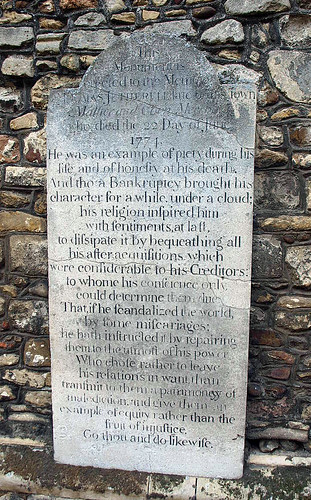
Looking across at this stone from the walls of All Saints Church is another curious stone, engraved in the 18th century with a moral lesson for all who pass by. It is to Thomas Jetherell, a maltster who died in 1774 and is declared to have been an example of piety in life and honesty in death. Bankruptcy brought his character under a cloud, but religion inspired him to bequeath all his acquisitions after that (which were considerable) to his creditors, so that if he scandalised the world by some miscarriages he repaired them to the utmost of his power, choosing to leave his relations in want rather than transmit to them a patrimony of malediction, rather giving them an example of equity than the fruit of injustice.

All Saints is one of two fine churches in Huntingdon; it has two old churches and two old inns. The churches are medieval, and the inns are 17th century. The Falcon has a cobbled courtyard with a long window over the gateway, and the George has a picturesque galleried yard with an oak staircase leading to a painted balcony.

The stately south front of All Saints looks out on the marketplace, an impressive background for the little square with its great aisle windows, the clerestory receding above, and the 14th century tower beyond. It has richly sculptured walls, a pinnacled and battlemented tower of the 14th century, and buttresses guarded by figures under canopied niches. The church is mainly 15th century. Inside, the eye is drawn by the beauty of the old chancel roof, its cornice carved with small faces, the beams adorned with tiny winged angels in gold, while eight great angels reach out from the walls looking down on the musical angels crowning the stalls. Everywhere on this roof are roses and crowns and stars, flowers and knots and shields, and bearing up the beams on the walls are wooden figures of saints resting on brackets of grotesque creatures in stone. Under this roof there rested for a night the body of Mary Queen of Scots on its way from her old grave in Peterborough to her new grave in Westminster Abbey.

The font at which Cromwell was baptised is older than the church it stands in; the bowl is 13th century, set on a new arcaded stem. The stained glass windows which darken the church have kneeling apostles, saints, and martyrs, including a Roman matron, St George and St Pancras, and men carrying models of Ely and Lincoln Cathedrals. The clerestory windows have 21 painted saints. Over the doorway in memory of Alice Weaver is her kneeling figure in alabaster, with her husband and six children; she would be stirred by the news that her famous townsman was leading the fight of the Parliament against the king.

St Mary’s Church comes from all our great building centuries, the chancel 13th, the tower and the west porch 14th, the clerestory 15th. It has at two corners of the south aisle fragments of Norman buttresses from which it is clear that the Norman church on this site must have been of great size. The chancel walls were raised when the clerestory was built in the 15th century; the north arcade of three bays was refashioned with the old material 300 years ago; the south arcade is the original 13th century. The tower is magnificent with pinnacles, a band of decoration below its battlements, and a charming doorway with a canopied niche on each side. About 600 years ago somebody scratched a drawing of a bell on one of its stones and the winds and rains of centuries have left it clear. In the south wall is a beautiful doorway through which priests have passed about 700 years.

The church is crowded with interest and beauty; it has a remarkable collection of small things. Hanging on the west wall is a group of flags among which is one captured from the Sikhs in 1846, a Boy Scout flag hanging with the flag flown in the Great War by HMS Walpole, and three fine banners made in Bruges. There are hanging lamps copied from old Italian and old Spanish lamps, two oak chests restored in the 17th century, two high-backed walnut chairs of Restoration days, an Elizabethan chalice, a 200-year-old copy of Guercino’s Holy Child, and a tiny fragment of a 14th century screen which is all that is left of the vanished church of St Benedict. In the south chapel are carved wooden figures and a beautiful Madonna in plaster, and in the north chapel is a fine gilt figure with outstretched arms, carved in wood by a craftsman in a Belgian village. One of the altars has a frontal of‘ great beauty made in Bruges, showing the angels bringing the good news to Mary. The chancel altar rails are by J. N. Comper, the gold angels on the uprights coming from Austria.

Set in the wall by the 13th century chancel arch is a small stone deeply cut with the names: R. Cromwell, I. Turpin, Bailiffs 1609. High above the chancel arch are four ancient figures carved out of solid oak about the end of the 15th century. They show four apostles, Stephen, Bartholomew, Jude, and Matthew, all carrying the Gospels and their emblems—flaying knives, a boat, and a carpenter’s square. Few small towns are more interesting out of doors than Huntingdon. It has fine old houses, stately churches, deserted churchyards, a noble bridge, an 18th century town hall extended just after Waterloo; the 18th century house in which the poet Cowper lived; the 17th century Walden House (now used by the County Council) with some 16th century woodwork; an 18th century house built by the Ferrars of Little Gidding with a little stained glass of Stuart days; the great ancestral home of the Cromwells, and, of course, the famous mound on which the ancient castle stood. We see it from the bridge which shares its fame as part of the oldest spectacle in this old town. The bridge, from which we see Huntingdon at its best, leads on to the great Causeway which links the town with Godmanchester. It is one of the loveliest stone bridges in England, as good a piece of stonework as the 13th century has left us, with carving over some of its arches, and with bays to protect the traveller from the dangers of its narrow way. From it we look across to the spacious green meadows with the great mound,  the elegant spire of Trinity Church rising above the roofs behind. Not far from where we stand is the long graceful house fronting the street, with dormers and a central pediment, where William Cowper came to live with "the most agreeable family in the world.”

Cowper came to Huntingdon in the summer of 1765, finding himself very soon on good terms with “no less than five families, besides two or three odd scrambling fellows like myself.” One of them was the Unwin family, destined to have so great an influence on his life; another was a North Country parson who travelled on foot 16 miles every Sunday to serve his churches, and who invited Cowper to supper on bread and cheese and a black jug of ale of his own brewing. Another friend the poet met was a thin, tall, old man as good as he was thin, drinking nothing but water and eating no meat, and to be met every morning of his life at 6 o’clock at a fountain a mile from the town. His great piety, said Cowper, was equalled by nothing but his great regularity: he was the most perfect timepiece in the world. As for Mrs Unwin, he met her in the street and went home with her and they walked for two hours in the garden, having a conversation which “did me more good than I should have received from an audience of the first prince of Europe.” He knew also the woollen draper, “a healthy, wealthy, sponsible man”; he had a cold bath and had promised the poet the key of it.

In the little market square on which the 12th century grammar school, the 15th century church, and the 18th century town hall look down, stands one of the best of all our peace memorials, a monument in bronze which somehow reminded us of The Thinker by‘Rodin; it is by the widow of Captain Scott (Lady Kennet), and shows a soldier sitting with his head resting on his hand. Four centuries have given something to this heart of Huntingdon, and here have stood these famous men who belonged to this small place: Cromwell, Pepys, Cowper. But the roll begins earlier and ends later than these, for Henry of Huntingdon wrote a 12th century history of England, and Sir Michael Foster, one of the greatest physiologists who ever lived, was born here on the eve of the Victorian Era and lies in the cemetery. He sleeps not far from where he first opened his eyes, but most of his long life he was away, though he joined his father’s Huntingdon surgery for a few years in the sixties of last century. At 31 he began teaching physiology in University College, London, and a few years later left for Cambridge, where Huxley recommended him for a post. He presided over the British Association, went into Parliament, founded a scientific society, and wrote a famous text book.

The Cromwell House at Huntingdon has vanished except for the bricks of its walls, which may be its successor; but the Cromwell House of Hinchingbrooke, where it is believed Oliver had his first encounter with Charles, remains in all its glory just outside the town.

St Mary, Huntingdon

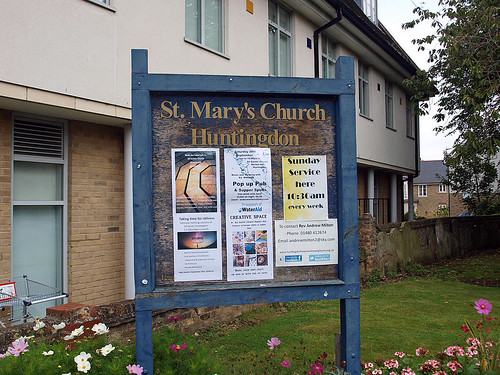
I sort of know that judging a church's future by the state of its notice board is to take a narrow view of the probable fate of the building, but I can't help but look at a tired notice board and think - you're probably fucked.

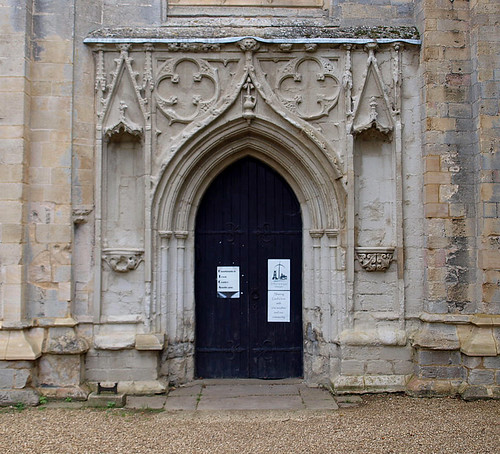
Sadly St Mary, locked no keyholder, feels like an abandoned relic, with a handwritten note tacked on the west door redirecting the bell ringers to All Saints. I also know that my impression of it being an unloved and uncared for building might be nonsense but that's what it felt like.

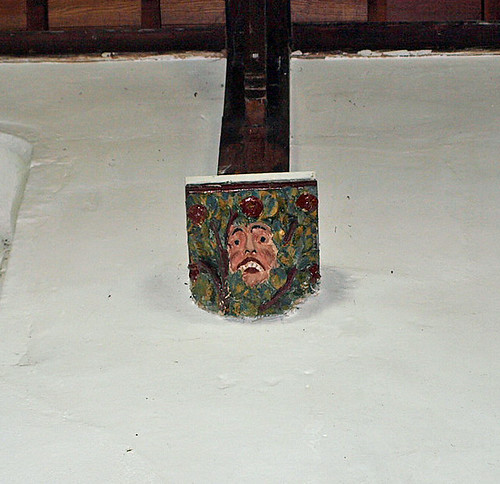
ST MARY, High Street. The W tower is the most ornate piece of the church, Perp, with a doorway flanked by niches and decorated with quatrefoils in spandrels, buttresses clasping and at the same time set-back and enriched by gablets, and niches for images on brackets with e.g. a Pelican and a Green Man, bell-openings as pairs of two-light openings, two quatrefoil friezes, and battlements and pinnacles. On the ground stage to the N was originally large gabled blank arcading. But the earliest parts of the church are first the remains of flat Norman buttresses in the SE corner of the nave and the SW corner of the S aisle - proving the existence of a large, aisled Norman church - and then the chancel, early C13, with a priest’s doorway which still has waterleaf capitals and also two lancet windows, shafted inside. The N one is re-set in the vestry; the other re-set window has Y-tracery and is hence of the late C13. The position of the priest’s doorway shows that the chancel was originally longer. The present E wall is of 1876. Aisles and clerestory appear Perp externally, but the arcades tell a different story. They are both E.E., S perhaps of c.1240, N of c.1260. Much of the N side and some of the S, however, are a C17 rebuilding after the tower had partly collapsed in 1607. The S arcade has a variety of supports. The W respond of the S arcade has a stiff-leaf capital on a short triple shaft, two piers are octagonal, one is round, and one consists of four keeled major and four minor shafts. The arches are of many fine mouldings, and the stops of the hood-mould are pretty stiff-leaf balls. The N arcade is simpler, mostly of standard elements, i.e. for instance double-chamfered arches. In several places are C17 inscriptions. - PLATE. Cup 1569-70; Cover Paten 1624-5; early C17 Cup and Cover Paten ; three engraved Plates 1684; Flagon 1726. - MONUMENTS. Tablets under the tower, the largest to the Carcassonnett family, 1749, assigned to Scheemakers (two pilasters, open pediment). - Also some enjoyable cartouches, e.g. d 1729.

St Mary (1)

W door (1)

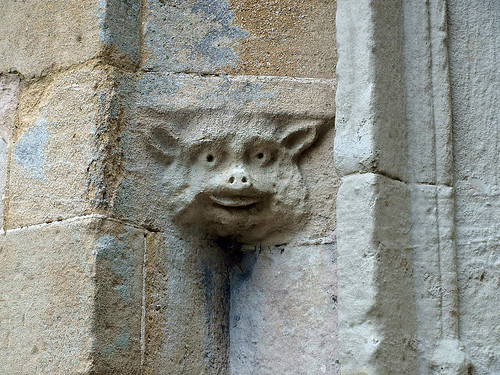
Corbel (2)

HUNTINGDON. Its streets have resounded with the tramp of Roman legions. The Saxons set a castle on the little green hills at the back of its square. The Normans built the school where Oliver Cromwell and Samuel Pepys both went as boys. Little can the people of Huntingdon who would see these boys playing in their streets have imagined that one would raise England to the height of power beyond the dream of kings, and that the other would leave behind him a picture of the life of England to be read for centuries.

It is enough to give a town a sense of great importance, yet Huntingdon makes no pretence to greatness; it is just an old-fashioned place where many things have happened. It has not thought it worth while to set up a statue of Oliver Cromwell at one end of its street and a statue of Pepys at the other; it was not until the other day that this old town had a single record in stone of the fact that it gave Oliver  Cromwell to the world.

Milton’s Chief of Men, our greatest man of action, was born at the bottom of Huntingdon’s long street. The long brick wall is here as it has been for centuries, for it was the boundary wall of the Augustinian Priory, and in the garden over the wall Cromwell would play in his boyhood. It is all there is to see of his birthplace as he knew it, for his house has gone. It is possible that part of the house now standing here may belong to the birthplace, and certainly much of the old materials was used; and it is certain that Cromwell’s garden was bounded by these brick walls. There is an arch that he would walk through, and, however changed the scene may be, it was here that that life began which shook the English throne, established securely the fame and freedom of our people, and gave history for all time a man to wonder at.

We walk about the scenes of his boyhood. He would walk from here along this street to the little Norman schoolroom facing the church in which he was baptised. The record of his birth and baptism are in the registers at All Saints, and there his father lies. Here his mother is not, for Oliver was to take her up to the Palace of Whitehall and lay her at last in the loveliest shrine in London, the Chapel of Henry the Seventh, where a dissolute king was to dig up her remains and throw them into a pit.

It is believed that she had great influence with Oliver in his early days. The story is that he was the terror of the neighbourhood, living a wild life, so that the ale-wives of Huntingdon were afraid of him. When the time came that his means would not allow extravagance (and especially when his rich Uncle Oliver at Hinchingbrooke became displeased with him), the brewer’s son changed his ways and gave way to his mother’s persuasions.

We may think that the little school looking down on the pavement of this long street is the most intimate Cromwell monument we have. It stands on the Roman way called Ermine Street, and it has still looking into the street a magnificent Norman doorway, a Norman window, and a row of five Norman arches. It is thrilling to us not only as a piece of Norman England, the hall of a 12th century hospital which became in time the grammar school of Huntingdon, but because to this little place came two boys whose names are famous throughout the world, Oliver himself, and Pepys. Pepys spent some of his boyhood in a village near by, and lived to see the great Oliver’s head stuck on a post at Westminster Hall, and to write in his diary that night that he did see this thing and did think it an indignity for a man so great.

Oliver’s father is described as having been extremely careful with his education, first putting him under Mr Long, a minister of Huntingdon, and then removing him to the grammar school under Dr Beard. It is stated somewhere that the boy had fits of learning, “now a hard student for a week or two, then a truant for a month or two, and of not settled constancy.” It was during his schooltime here that he was flogged by Dr Beard for telling the story of a vision in which he saw a gigantic figure opening the curtains of his bed and declaring that he should be the greatest person in the kingdom. Whether that be true or not, it appears to be true that during his schooldays here the comedy of Lingua was played and nothing would satisfy Cromwell but the part of Tactus. The idea of the comedy, which was first printed in 1607 and first acted at Trinity College, Cambridge, is a combat between the Five Senses for superiority, and one of the scenes in the first act is a conversation between Tactus and Mendacio, during which Tactus fumbles with a crown:

Tactus: A crown and robe!
Mendacio: It had been better for you to have found a fool ’s coat, and a bauble.
Tactus: Tis wondrous rich: ha! but sure it is not so: Do I not sleep and dream of this good luck?


Then comes a scene in which Tactus is soliloquising:

This crown and robe,
My brows and body circle; and invests,
How gallantly it fits me, sure the slave
Measured my head that wrought this coronet,
They lie who say complexions cannot change,
My blood’s ennobled, and I am transformed
Unto the sacred temper of a king.
Methinks I hear my noble parasites
Styling me Caesar, or great Alexander,
Licking my feet, and wondering where I got
This precious ointment, how my pace is mended,
How princely do I speak, how sharp I threaten:
Peasants, I’ll curb your headstrong impudence,
And make you tremble when the lion roars.


It is believed that Huntingdon rejected the statue of Cromwell now standing in St Ives, but its mayor and corporation made amend by giving their blessing to the stone set in 1938 by the Norman doorway, recording the fact that Cromwell attended this school. It is the only memorial of Cromwell in the town, and was presented by the Cromwell Association in a speech by Mr Isaac Foot and unveiled by the Earl of Sandwich, who arranged for its beautiful heraldic carving to be copied from the badge on Cromwell’s leather water bottle, which is now at Hinchingbrooke, the superb Tudor house of the Cromwells a mile away.

Looking across at this stone from the walls of All Saints Church is another curious stone, engraved in the 18th century with a moral lesson for all who pass by. It is to Thomas Jetherell, a maltster who died in 1774 and is declared to have been an example of piety in life and honesty in death. Bankruptcy brought his character under a cloud, but religion inspired him to bequeath all his acquisitions after that (which were considerable) to his creditors, so that if he scandalised the world by some miscarriages he repaired them to the utmost of his power, choosing to leave his relations in want rather than transmit to them a patrimony of malediction, rather giving them an example of equity than the fruit of injustice.

All Saints is one of two fine churches in Huntingdon; it has two old churches and two old inns. The churches are medieval, and the inns are 17th century. The Falcon has a cobbled courtyard with a long window over the gateway, and the George has a picturesque galleried yard with an oak staircase leading to a painted balcony.

The stately south front of All Saints looks out on the marketplace, an impressive background for the little square with its great aisle windows, the clerestory receding above, and the 14th century tower beyond. It has richly sculptured walls, a pinnacled and battlemented tower of the 14th century, and buttresses guarded by figures under canopied niches. The church is mainly 15th century. Inside, the eye is drawn by the beauty of the old chancel roof, its cornice carved with small faces, the beams adorned with tiny winged angels in gold, while eight great angels reach out from the walls looking down on the musical angels crowning the stalls. Everywhere on this roof are roses and crowns and stars, flowers and knots and shields, and bearing up the beams on the walls are wooden figures of saints resting on brackets of grotesque creatures in stone. Under this roof there rested for a night the body of Mary Queen of Scots on its way from her old grave in Peterborough to her new grave in Westminster Abbey.

The font at which Cromwell was baptised is older than the church it stands in; the bowl is 13th century, set on a new arcaded stem. The stained glass windows which darken the church have kneeling apostles, saints, and martyrs, including a Roman matron, St George and St Pancras, and men carrying models of Ely and Lincoln Cathedrals. The clerestory windows have 21 painted saints. Over the doorway in memory of Alice Weaver is her kneeling figure in alabaster, with her husband and six children; she would be stirred by the news that her famous townsman was leading the fight of the Parliament against the king.

St Mary’s Church comes from all our great building centuries, the chancel 13th, the tower and the west porch 14th, the clerestory 15th. It has at two corners of the south aisle fragments of Norman buttresses from which it is clear that the Norman church on this site must have been of great size. The chancel walls were raised when the clerestory was built in the 15th century; the north arcade of three bays was refashioned with the old material 300 years ago; the south arcade is the original 13th century. The tower is magnificent with pinnacles, a band of decoration below its battlements, and a charming doorway with a canopied niche on each side. About 600 years ago somebody scratched a drawing of a bell on one of its stones and the winds and rains of centuries have left it clear. In the south wall is a beautiful doorway through which priests have passed about 700 years.

The church is crowded with interest and beauty; it has a remarkable collection of small things. Hanging on the west wall is a group of flags among which is one captured from the Sikhs in 1846, a Boy Scout flag hanging with the flag flown in the Great War by HMS Walpole, and three fine banners made in Bruges. There are hanging lamps copied from old Italian and old Spanish lamps, two oak chests restored in the 17th century, two high-backed walnut chairs of Restoration days, an Elizabethan chalice, a 200-year-old copy of Guercino’s Holy Child, and a tiny fragment of a 14th century screen which is all that is left of the vanished church of St Benedict. In the south chapel are carved wooden figures and a beautiful Madonna in plaster, and in the north chapel is a fine gilt figure with outstretched arms, carved in wood by a craftsman in a Belgian village. One of the altars has a frontal of‘ great beauty made in Bruges, showing the angels bringing the good news to Mary. The chancel altar rails are by J. N. Comper, the gold angels on the uprights coming from Austria.

Set in the wall by the 13th century chancel arch is a small stone deeply cut with the names: R. Cromwell, I. Turpin, Bailiffs 1609. High above the chancel arch are four ancient figures carved out of solid oak about the end of the 15th century. They show four apostles, Stephen, Bartholomew, Jude, and Matthew, all carrying the Gospels and their emblems—flaying knives, a boat, and a carpenter’s square. Few small towns are more interesting out of doors than Huntingdon. It has fine old houses, stately churches, deserted churchyards, a noble bridge, an 18th century town hall extended just after Waterloo; the 18th century house in which the poet Cowper lived; the 17th century Walden House (now used by the County Council) with some 16th century woodwork; an 18th century house built by the Ferrars of Little Gidding with a little stained glass of Stuart days; the great ancestral home of the Cromwells, and, of course, the famous mound on which the ancient castle stood. We see it from the bridge which shares its fame as part of the oldest spectacle in this old town. The bridge, from which we see Huntingdon at its best, leads on to the great Causeway which links the town with Godmanchester. It is one of the loveliest stone bridges in England, as good a piece of stonework as the 13th century has left us, with carving over some of its arches, and with bays to protect the traveller from the dangers of its narrow way. From it we look across to the spacious green meadows with the great mound,  the elegant spire of Trinity Church rising above the roofs behind. Not far from where we stand is the long graceful house fronting the street, with dormers and a central pediment, where William Cowper came to live with "the most agreeable family in the world.”

Cowper came to Huntingdon in the summer of 1765, finding himself very soon on good terms with “no less than five families, besides two or three odd scrambling fellows like myself.” One of them was the Unwin family, destined to have so great an influence on his life; another was a North Country parson who travelled on foot 16 miles every Sunday to serve his churches, and who invited Cowper to supper on bread and cheese and a black jug of ale of his own brewing. Another friend the poet met was a thin, tall, old man as good as he was thin, drinking nothing but water and eating no meat, and to be met every morning of his life at 6 o’clock at a fountain a mile from the town. His great piety, said Cowper, was equalled by nothing but his great regularity: he was the most perfect timepiece in the world. As for Mrs Unwin, he met her in the street and went home with her and they walked for two hours in the garden, having a conversation which “did me more good than I should have received from an audience of the first prince of Europe.” He knew also the woollen draper, “a healthy, wealthy, sponsible man”; he had a cold bath and had promised the poet the key of it.

In the little market square on which the 12th century grammar school, the 15th century church, and the 18th century town hall look down, stands one of the best of all our peace memorials, a monument in bronze which somehow reminded us of The Thinker by‘Rodin; it is by the widow of Captain Scott (Lady Kennet), and shows a soldier sitting with his head resting on his hand. Four centuries have given something to this heart of Huntingdon, and here have stood these famous men who belonged to this small place: Cromwell, Pepys, Cowper. But the roll begins earlier and ends later than these, for Henry of Huntingdon wrote a 12th century history of England, and Sir Michael Foster, one of the greatest physiologists who ever lived, was born here on the eve of the Victorian Era and lies in the cemetery. He sleeps not far from where he first opened his eyes, but most of his long life he was away, though he joined his father’s Huntingdon surgery for a few years in the sixties of last century. At 31 he began teaching physiology in University College, London, and a few years later left for Cambridge, where Huxley recommended him for a post. He presided over the British Association, went into Parliament, founded a scientific society, and wrote a famous text book.

The Cromwell House at Huntingdon has vanished except for the bricks of its walls, which may be its successor; but the Cromwell House of Hinchingbrooke, where it is believed Oliver had his first encounter with Charles, remains in all its glory just outside the town.

Thursday, 21 September 2017

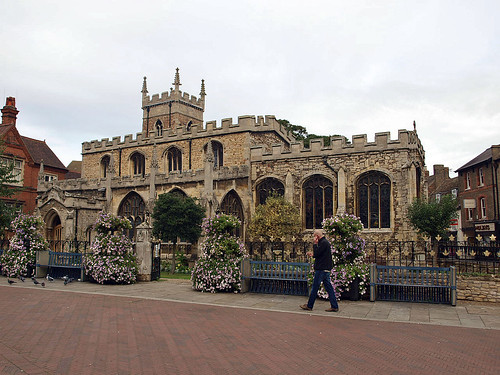
All Saints, Huntingdon

I was amazed to find All Saints locked with no keyholder listed [and without a church notice board] - why? you may ask and I would explain that it's naturally locked by an unfathomable one way system, which any potential thief would find hard to decode, and that it sits in a very busy pedestrianised square where any malpractice could not fail to be noticed.

Whatsoever - it's locked and Pevsner doesn't make it sound too interesting but, and keep in mind that I know nothing about Huntingdon or its populace, what sort of message does a lockdown church send to the expectant visitor? I've found open churches in rougher parts of London that should make the incumbent hang his, or her, head in shame.

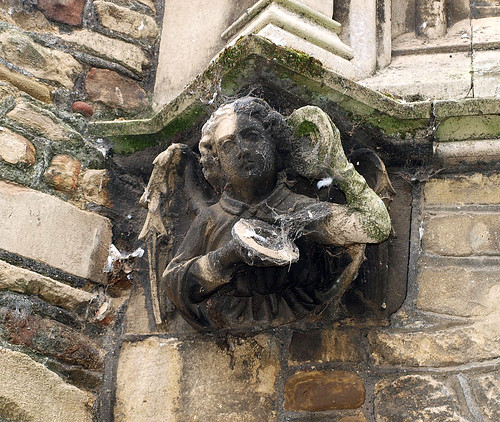
ALL SAINTS. Along the Market Place. The E end is close to the High Street. The church is varied in outline and fits well into its surroundings. The tower is placed at the corner. It was set into an existing building, as its S wall stands on the first bay of an E.E. N arcade, the oldest remaining feature.* That it was an arcade and not a tower arch is evident from the fact that the W respond of the arch is a respond indeed - it has stiff-leaf decoration - but that the E respond is simply a round pier with an octagonal abacus. The upper parts of the tower are of brick, rebuilt after the Civil War, and the very top is Victorian. Otherwise the church is essentially Perp, except for the N aisle windows, which with their crocketed arches and tracery look Dec, and the organ chamber and vestry, which are by Sir G. G. Scott, of  1859. The organ chamber is the prettiest feature of the church, with its angel at the apex playing on a positive organ. The arcades, of four (on the N side of course three) bays, are characteristically Early Perp. Piers of standard moulded section, arches of two sunk-quadrant mouldings, the arch tops slightly ogee. The E window of the S aisle has mullions carried down blank to form a reredos. In the SE corner charming niche on a foliated corbel and with a canopy. Good Perp chancel roof with carved bosses. - STAINED GLASS. The clerestory windows are of 1860, by Clayton & Bell. - By the same the former chancel E window, now in the W wall of the S aisle. It shows the Te Deum in the presence of Prophets, Apostles, and Saints, and also the Venerable Bede, William of Wykeham, Archbishop Cranmer, Bishop Ridley, George Herbert, Newton, Handel, Queen Victoria and Prince ‘Albert, and the Duke of Weflington. - The W Window is by Kempe, 1900 (with his wheatsheaf). - The E window is by Tower, Kempe’s successor, c.1920. - PLATE. Flemish Chalice of c.1750; silver-gilt. - MONUMENT. Alice Weaver d. 1636. Tablet with kneeling figures in relief. The top has already - very early - an open scrolly pediment. - Good Victorian CHURCHYARD RAILINGS.

* But some N walling is Norman.

Thomas Jetherell 1774

Corbel (6)

All Saints (5)

HUNTINGDON. Its streets have resounded with the tramp of Roman legions. The Saxons set a castle on the little green hills at the back of its square. The Normans built the school where Oliver Cromwell and Samuel Pepys both went as boys. Little can the people of Huntingdon who would see these boys playing in their streets have imagined that one would raise England to the height of power beyond the dream of kings, and that the other would leave behind him a picture of the life of England to be read for centuries.

It is enough to give a town a sense of great importance, yet Huntingdon makes no pretence to greatness; it is just an old-fashioned place where many things have happened. It has not thought it worth while to set up a statue of Oliver Cromwell at one end of its street and a statue of Pepys at the other; it was not until the other day that this old town had a single record in stone of the fact that it gave Oliver  Cromwell to the world.

Milton’s Chief of Men, our greatest man of action, was born at the bottom of Huntingdon’s long street. The long brick wall is here as it has been for centuries, for it was the boundary wall of the Augustinian Priory, and in the garden over the wall Cromwell would play in his boyhood. It is all there is to see of his birthplace as he knew it, for his house has gone. It is possible that part of the house now standing here may belong to the birthplace, and certainly much of the old materials was used; and it is certain that Cromwell’s garden was bounded by these brick walls. There is an arch that he would walk through, and, however changed the scene may be, it was here that that life began which shook the English throne, established securely the fame and freedom of our people, and gave history for all time a man to wonder at.

We walk about the scenes of his boyhood. He would walk from here along this street to the little Norman schoolroom facing the church in which he was baptised. The record of his birth and baptism are in the registers at All Saints, and there his father lies. Here his mother is not, for Oliver was to take her up to the Palace of Whitehall and lay her at last in the loveliest shrine in London, the Chapel of Henry the Seventh, where a dissolute king was to dig up her remains and throw them into a pit.

It is believed that she had great influence with Oliver in his early days. The story is that he was the terror of the neighbourhood, living a wild life, so that the ale-wives of Huntingdon were afraid of him. When the time came that his means would not allow extravagance (and especially when his rich Uncle Oliver at Hinchingbrooke became displeased with him), the brewer’s son changed his ways and gave way to his mother’s persuasions.

We may think that the little school looking down on the pavement of this long street is the most intimate Cromwell monument we have. It stands on the Roman way called Ermine Street, and it has still looking into the street a magnificent Norman doorway, a Norman window, and a row of five Norman arches. It is thrilling to us not only as a piece of Norman England, the hall of a 12th century hospital which became in time the grammar school of Huntingdon, but because to this little place came two boys whose names are famous throughout the world, Oliver himself, and Pepys. Pepys spent some of his boyhood in a village near by, and lived to see the great Oliver’s head stuck on a post at Westminster Hall, and to write in his diary that night that he did see this thing and did think it an indignity for a man so great.

Oliver’s father is described as having been extremely careful with his education, first putting him under Mr Long, a minister of Huntingdon, and then removing him to the grammar school under Dr Beard. It is stated somewhere that the boy had fits of learning, “now a hard student for a week or two, then a truant for a month or two, and of not settled constancy.” It was during his schooltime here that he was flogged by Dr Beard for telling the story of a vision in which he saw a gigantic figure opening the curtains of his bed and declaring that he should be the greatest person in the kingdom. Whether that be true or not, it appears to be true that during his schooldays here the comedy of Lingua was played and nothing would satisfy Cromwell but the part of Tactus. The idea of the comedy, which was first printed in 1607 and first acted at Trinity College, Cambridge, is a combat between the Five Senses for superiority, and one of the scenes in the first act is a conversation between Tactus and Mendacio, during which Tactus fumbles with a crown:

Tactus: A crown and robe!
Mendacio: It had been better for you to have found a fool ’s coat, and a bauble.
Tactus: Tis wondrous rich: ha! but sure it is not so: Do I not sleep and dream of this good luck?


Then comes a scene in which Tactus is soliloquising:

This crown and robe,
My brows and body circle; and invests,
How gallantly it fits me, sure the slave
Measured my head that wrought this coronet,
They lie who say complexions cannot change,
My blood’s ennobled, and I am transformed
Unto the sacred temper of a king.
Methinks I hear my noble parasites
Styling me Caesar, or great Alexander,
Licking my feet, and wondering where I got
This precious ointment, how my pace is mended,
How princely do I speak, how sharp I threaten:
Peasants, I’ll curb your headstrong impudence,
And make you tremble when the lion roars.


It is believed that Huntingdon rejected the statue of Cromwell now standing in St Ives, but its mayor and corporation made amend by giving their blessing to the stone set in 1938 by the Norman doorway, recording the fact that Cromwell attended this school. It is the only memorial of Cromwell in the town, and was presented by the Cromwell Association in a speech by Mr Isaac Foot and unveiled by the Earl of Sandwich, who arranged for its beautiful heraldic carving to be copied from the badge on Cromwell’s leather water bottle, which is now at Hinchingbrooke, the superb Tudor house of the Cromwells a mile away.

Looking across at this stone from the walls of All Saints Church is another curious stone, engraved in the 18th century with a moral lesson for all who pass by. It is to Thomas Jetherell, a maltster who died in 1774 and is declared to have been an example of piety in life and honesty in death. Bankruptcy brought his character under a cloud, but religion inspired him to bequeath all his acquisitions after that (which were considerable) to his creditors, so that if he scandalised the world by some miscarriages he repaired them to the utmost of his power, choosing to leave his relations in want rather than transmit to them a patrimony of malediction, rather giving them an example of equity than the fruit of injustice.

All Saints is one of two fine churches in Huntingdon; it has two old churches and two old inns. The churches are medieval, and the inns are 17th century. The Falcon has a cobbled courtyard with a long window over the gateway, and the George has a picturesque galleried yard with an oak staircase leading to a painted balcony.

The stately south front of All Saints looks out on the marketplace, an impressive background for the little square with its great aisle windows, the clerestory receding above, and the 14th century tower beyond. It has richly sculptured walls, a pinnacled and battlemented tower of the 14th century, and buttresses guarded by figures under canopied niches. The church is mainly 15th century. Inside, the eye is drawn by the beauty of the old chancel roof, its cornice carved with small faces, the beams adorned with tiny winged angels in gold, while eight great angels reach out from the walls looking down on the musical angels crowning the stalls. Everywhere on this roof are roses and crowns and stars, flowers and knots and shields, and bearing up the beams on the walls are wooden figures of saints resting on brackets of grotesque creatures in stone. Under this roof there rested for a night the body of Mary Queen of Scots on its way from her old grave in Peterborough to her new grave in Westminster Abbey.

The font at which Cromwell was baptised is older than the church it stands in; the bowl is 13th century, set on a new arcaded stem. The stained glass windows which darken the church have kneeling apostles, saints, and martyrs, including a Roman matron, St George and St Pancras, and men carrying models of Ely and Lincoln Cathedrals. The clerestory windows have 21 painted saints. Over the doorway in memory of Alice Weaver is her kneeling figure in alabaster, with her husband and six children; she would be stirred by the news that her famous townsman was leading the fight of the Parliament against the king.

St Mary’s Church comes from all our great building centuries, the chancel 13th, the tower and the west porch 14th, the clerestory 15th. It has at two corners of the south aisle fragments of Norman buttresses from which it is clear that the Norman church on this site must have been of great size. The chancel walls were raised when the clerestory was built in the 15th century; the north arcade of three bays was refashioned with the old material 300 years ago; the south arcade is the original 13th century. The tower is magnificent with pinnacles, a band of decoration below its battlements, and a charming doorway with a canopied niche on each side. About 600 years ago somebody scratched a drawing of a bell on one of its stones and the winds and rains of centuries have left it clear. In the south wall is a beautiful doorway through which priests have passed about 700 years.

The church is crowded with interest and beauty; it has a remarkable collection of small things. Hanging on the west wall is a group of flags among which is one captured from the Sikhs in 1846, a Boy Scout flag hanging with the flag flown in the Great War by HMS Walpole, and three fine banners made in Bruges. There are hanging lamps copied from old Italian and old Spanish lamps, two oak chests restored in the 17th century, two high-backed walnut chairs of Restoration days, an Elizabethan chalice, a 200-year-old copy of Guercino’s Holy Child, and a tiny fragment of a 14th century screen which is all that is left of the vanished church of St Benedict. In the south chapel are carved wooden figures and a beautiful Madonna in plaster, and in the north chapel is a fine gilt figure with outstretched arms, carved in wood by a craftsman in a Belgian village. One of the altars has a frontal of‘ great beauty made in Bruges, showing the angels bringing the good news to Mary. The chancel altar rails are by J. N. Comper, the gold angels on the uprights coming from Austria.

Set in the wall by the 13th century chancel arch is a small stone deeply cut with the names: R. Cromwell, I. Turpin, Bailiffs 1609. High above the chancel arch are four ancient figures carved out of solid oak about the end of the 15th century. They show four apostles, Stephen, Bartholomew, Jude, and Matthew, all carrying the Gospels and their emblems—flaying knives, a boat, and a carpenter’s square. Few small towns are more interesting out of doors than Huntingdon. It has fine old houses, stately churches, deserted churchyards, a noble bridge, an 18th century town hall extended just after Waterloo; the 18th century house in which the poet Cowper lived; the 17th century Walden House (now used by the County Council) with some 16th century woodwork; an 18th century house built by the Ferrars of Little Gidding with a little stained glass of Stuart days; the great ancestral home of the Cromwells, and, of course, the famous mound on which the ancient castle stood. We see it from the bridge which shares its fame as part of the oldest spectacle in this old town. The bridge, from which we see Huntingdon at its best, leads on to the great Causeway which links the town with Godmanchester. It is one of the loveliest stone bridges in England, as good a piece of stonework as the 13th century has left us, with carving over some of its arches, and with bays to protect the traveller from the dangers of its narrow way. From it we look across to the spacious green meadows with the great mound,  the elegant spire of Trinity Church rising above the roofs behind. Not far from where we stand is the long graceful house fronting the street, with dormers and a central pediment, where William Cowper came to live with "the most agreeable family in the world.”

Cowper came to Huntingdon in the summer of 1765, finding himself very soon on good terms with “no less than five families, besides two or three odd scrambling fellows like myself.” One of them was the Unwin family, destined to have so great an influence on his life; another was a North Country parson who travelled on foot 16 miles every Sunday to serve his churches, and who invited Cowper to supper on bread and cheese and a black jug of ale of his own brewing. Another friend the poet met was a thin, tall, old man as good as he was thin, drinking nothing but water and eating no meat, and to be met every morning of his life at 6 o’clock at a fountain a mile from the town. His great piety, said Cowper, was equalled by nothing but his great regularity: he was the most perfect timepiece in the world. As for Mrs Unwin, he met her in the street and went home with her and they walked for two hours in the garden, having a conversation which “did me more good than I should have received from an audience of the first prince of Europe.” He knew also the woollen draper, “a healthy, wealthy, sponsible man”; he had a cold bath and had promised the poet the key of it.

In the little market square on which the 12th century grammar school, the 15th century church, and the 18th century town hall look down, stands one of the best of all our peace memorials, a monument in bronze which somehow reminded us of The Thinker by‘Rodin; it is by the widow of Captain Scott (Lady Kennet), and shows a soldier sitting with his head resting on his hand. Four centuries have given something to this heart of Huntingdon, and here have stood these famous men who belonged to this small place: Cromwell, Pepys, Cowper. But the roll begins earlier and ends later than these, for Henry of Huntingdon wrote a 12th century history of England, and Sir Michael Foster, one of the greatest physiologists who ever lived, was born here on the eve of the Victorian Era and lies in the cemetery. He sleeps not far from where he first opened his eyes, but most of his long life he was away, though he joined his father’s Huntingdon surgery for a few years in the sixties of last century. At 31 he began teaching physiology in University College, London, and a few years later left for Cambridge, where Huxley recommended him for a post. He presided over the British Association, went into Parliament, founded a scientific society, and wrote a famous text book.

The Cromwell House at Huntingdon has vanished except for the bricks of its walls, which may be its successor; but the Cromwell House of Hinchingbrooke, where it is believed Oliver had his first encounter with Charles, remains in all its glory just outside the town.


Sunday, 13 August 2017

Holywell cum Needingworth

St John the Baptist, open, is pretty much perfect both architecturally and location wise, inside maybe not so much so but there's enough interest to be pleasing. A great church with lots to reward the visitor.

ST JOHN BAPTIST. The W tower is a mystery. It is said to date from 1547 and to be built of stone from Ramsey Abbey. What does that statement involve? The tower is broad and substantial and built of regular stone blocks. Its buttresses start with chamfers, i.e. semi-polygonal, and the W window is indeed Tudor. But the bell-openings are Dec, and the doorway with its broadly rounded-trefoiled head and the big cusped tracery motifs of the spandrels defeats dating. The arch towards the nave is Dec anyway, and in the N and S walls are thin blank arches which are Dec too and fulfil no useful function in their position. Is it then all re-used Ramsey material? The body of the church is stone and cobbles, and the features are over-restored. The chancel is a beautiful early C13 piece with paired lancet windows, with a detached middle shaft between them inside and a rib rising from the shaft to the rere-arch, an unexpected personal touch. The aisle windows are Early Dec. So are the three-bay arcades with their standard elements. The roof of the nave is of 1862, but figures from the old roof are displayed in the church. - PLATE. Cup 1822-3; Paten on foot 1834-5.

Corbel (2)

East window detail

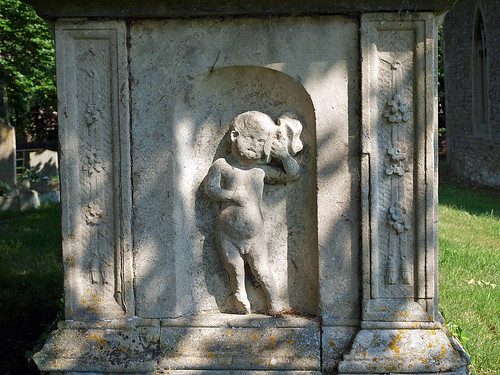
Table tomb (2)

HOLYWELL-CUM-NEEDINGWORTH. They are two small villages sharing a church. Holywell near the Ouse has a holy well by the church with a medieval carving over it; Needingworth, having lost almost all by fire (86 houses) last century, has hardly anything left of those Tudor days when its little son Ambrose Nicholas walked about here dreaming perhaps of being Lord Mayor of London - a dream which, whether he dreamt it or not, came true.

The small church is 12th and 13th century, the clerestory added in the 14th century to light the roodloft, and the tower built in the 16th century of Barnack stone from the ruined abbey of Ramsay. The font has a modern bowl on portions of a 13th century base, and the modern roof of the nave has eight figures 500 years old. They are probably part of the old roodloft, which was taken down in 1563 and put back in the church in 1581 to form a front to a west gallery, which existed for. 300 years and has now disappeared.

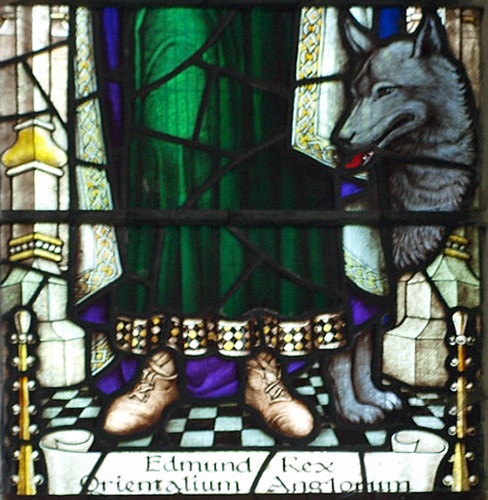
The modern east window, with glass by Sir Charles Nicholson, shows Our Lord, King Edmund, and St Oswald, the panels below showing scenes in their lives: the Supper at Emmaus, the martyrdom of Edmund, and Oswald presenting the deeds of the manor of Needingworth, which he bought from King Edgar, and a noble Saxon lady who presented the church at Holywell. In the top light is a view of the holy well, which is still in the churchyard.

Fenstanton

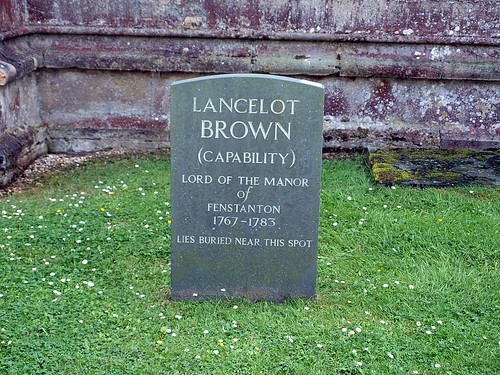
SS Peter & Paul, open, is a barn of a church which I found, despite having roof angels, some good corbels and a quantity of pleasing glass, rather soulless. It's too airbrushed and sterilised for my taste. It is also home to Capability Brown and his family.

ST PETER AND ST PAUL. The most interesting part of the church is the chancel. It is higher than the nave, and has a proud seven-light E window and high three-light side windows with reticulated tracery such as also appears prominently in the E window. The priest’s doorway is well moulded, and the SEDILIA and PISCINA have an even row of ogee arches. Now this chancel was built by William of Longthorne, whose brass - now only the indent - is in the middle of the floor, and he was rector from 1345 till 1352. The lettering on the tomb-slab incidentally is still Lombardic. So here is a dated piece of the mature Dec. The W tower cannot have been started much later. The W doorway is also still Dec. To it belong the two fragmentary windows to S and N cancelled when the mason of the Perp church decided upon aisles to embrace the tower. The head corbels of these new S and N arches look C13, but they must be re-used. The church is of rubble and brown cobbles. The ashlar spire with low broaches is Perp. Two tiers of lucarnes in alternating directions. Perp aisles and clerestory, Perp arcades of three wide bays, the piers with four polygonal projections and four diagonal hollows. Tower arch and chancel arch more or less match, though the bases of the chancel arch are E.E. As early. as this is the S porch entrance, re-set no doubt. This has dogtooth and an almond-shaped recess above. - PULPIT. With linenfold panels of the early C16. - PLATE. Silver-gilt Cup of 1619-20.  - MONUMENTS. For William of Longthorne see above. - Lancelot Brown d. 1783, i.e. Capability Brown, the celebrated garden designer. He was Lord of the Manor. The monument is a flat tomb-chest on steps with a back plate with modest Gothic detail. The inscription reads:

Ye Sons of Elegance, who truly taste
The Simple charms that genuine Art supplies,
Come from the sylvan Scenes His Genius grac’d,
And offer here your tributory Sigh’s.
But know that more than Genius slumbers here;
Virtues were his which Arts best powers transcend.
Come, ye Superior train, who these revere
And weep the Christian, Husband, Father, Friend.

- Mrs Brown, by Coade, 1793, i.e. made of Coade stone, and apparently designed by Bacon. Mourning woman by an urn on a pedestal. The pretty corbel is of Coade stone too.

Capability Brown

Piscina & Sedilla

Ward & Hughes E window 1874 (27)

FENSTANTON. It is on the Roman Road from Cambridge to Godmanchester, with the Fens about. Its houses have become good friends of time, and there is a quaint old lock-up of the 18th century which has now become a friendly place with a white bell turret, a clock, and a seat for weary travellers. The noble church tower with its spire has been a landmark 600 years, and in the churchyard is a fragment of a cross which has kept it company all the time. The view of the south wall is delightful, with the 15th century clerestory windows, the 16th century aisle windows, and the noble tower and spire soaring over all.

The tower has a lofty 15th century arch leading to the nave, but its side arches are 200 years older. There is a spacious porch as old as the tower, and a medieval nave roof with carvings and 18 old stone faces on the corbels. The lectern has old oak panels with good tracery. The pulpit in which Thomas Bourdillon preached for 52 years last century is 400 years old. In the Tudor roof of the north aisle are eight feathered angels holding crowns, lutes, and shields, with eight smaller figures.

But the glory of the village is the 14th century chancel, a spacious and lovely place, with a tremendous east window famous for its seven lancets and its graceful tracery. On one of the buttresses is an old mass dial. Here lies the man who built the chancel, William Longthome, rector a year or two before Crecy; there is a slab with his figure carved on it.

Long after his day another lover of beauty died in this village. He was Lancelot Brown, - always known as Capability Brown. His 17th century manor house is still here, said to have been given to him by the Earl of Northampton in gratitude for the wonderful gardens he laid out at Castle Ashby. His only monument here is a tablet, but it has eight lines that are a worthy tribute:

Ye sons of elegance who truly taste
The sample charms that genuine art supplies,
Come from the Sylvan scenes his genius graced
And ofler here your tributary sighs.
But know that more than genius slumbers here;
Virtues were his which art’s best powers transcend.
Come, ye superior train who these revere,
And weep the Christian husband, father, friend

.
In this country of great and beautiful gardens Capability Brown must be long remembered. Born at Kirkdale, Northumberland, in 1715, he started work as a gardener there in Lorraine Park. Ambition drove him south, where he found a footing in the kitchen garden of Lord Cobham at Stow. Here his talent flowered, and the man with the hoe was found to be a man with the eye of an artist. He had the faculty of seeing how an English landscape should be draped and dressed. He struck remorselessly at the prim geometrical scheme of gardening then in vogue, and made his trees and shrubs and plants fit in with and enhance the natural charm of a situation.

“The capability of the site” was his constantly recurring phrase as new undertakings were presented to him, and so Capability Brown he became in all men’s mouths. It was soon possible for him to set up independently as a landscape gardener, and he was in general request among the owners of parks and fine gardens.

Kew, Newnham Courtenay, and Blenheim were among the triumphs of his genius. Like Paxton, he was an architect too. He knew how to design a supremely comfortable and attractive -home, and from the time he was 36, when he began his second venture by building the church and dwelling for Lord Coventry at Croome, he was as active with schemes for architecture as in harmonising artificial cultivation with the natural configuration of landscapes. He made great gardens, let us say, as an artist makes pictures.

He was rewarded with a considerable fortune, was High Sheriff of Huntingdonshire, and died here in 1783.

Hilton

St Mary Magdalene, open, is not a particularly interesting building but its location is stunning which more than compensates for the over restored interior and there's also a Saxon cross reset in the west wall, as well as an alabaster remnant in the chancel.

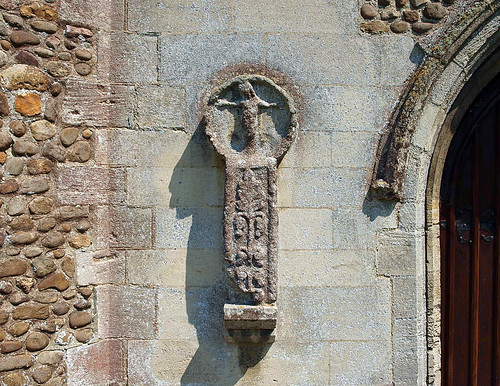
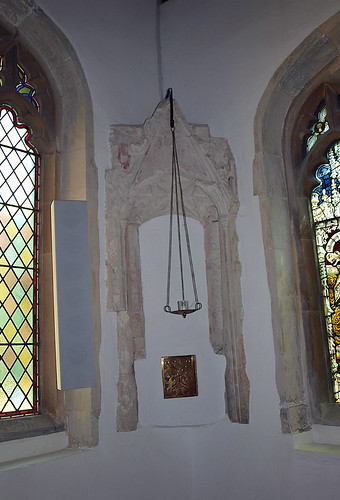
ST MARY MAGDALENE. C14 W tower, the rest Perp. Brown cobbles. The arcades of four bays have typical Perp piers with capitals only to the arch openings. In the chancel a bracket on a head, in the S aisle a very pretty but mutilated vaulted niche. - SCULPTURE. Small, strange stone of keyhole shape now in the W wall of the tower. In the upper part the Crucifix, in the lower defaced foliage. - STAINED GLASS. In a chancel N window a head of Christ. - The E window by Wailes of Newcastle, 1861, the W window by Constable of Cambridge; both bad. - Also two windows by Kempe, 1896 and 1898. - PLATE. Cup and Cover Paten 1571-2; Paten on foot 1681-2. - MONUMENT. Two alabaster pieces from a tomb-chest, one with two quatrefoils enclosing shields, the other with two kneeling angels holding a shield.

Saxon cross (1)

Vaulted niche

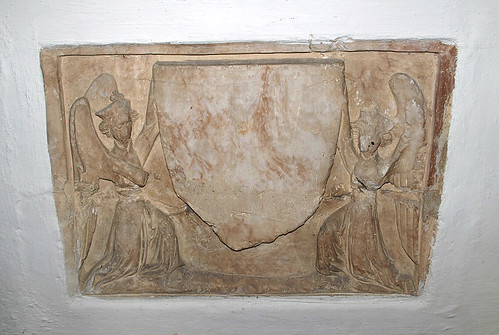
Alabaster angels (2)

HILTON. It is thrilling to find Roman brick in its church walls, made by Romans and first used by them, used again probably by the Saxons and the Normans, and again by our English builders.

The chancel arch was new about 700 years ago, the tower is a few years younger; the fine plain roofs are 15th century, as old as the font. From that great building century has also come the fragment of glass with the head of Christ in one of the windows. There is a 17th century chest. It is said that parts of the churchyard wall are 500 years old, and the’ stone cross with rich foliage and a battered Crucifixion in a circle is perhaps older still. Hilton Hall with its mellow bricks and stones has a dovecot 300 years old, and St John’s Farm goes back 500 years.

We were delighted to find in this place one of those rare survivals of Merrie England, a maze cut in the turf. It has a stone pillar in the middle on which the inscription tells us that it was made in 1660 by William Sparrow. We found two boys who showed how to reach the pillar without cheating. Often must old Robert Walpole have watched people finding their way in and finding their way out. He saw the maze made before his long life ended in the last year of the 17th century. He was 101, and had he lived a few years more would have seen three centuries; yet he had enough to boast about, for he was a child when Elizabeth was old and when Shakespeare was writing his plays; the Mayflower sailed in his youth, Charles and Cromwell were fighting in his prime, and when London was burning he still had before him another thirty years of sitting in the chimney corner talking of old times.